Product Sense in the Age of Burnout: A Reflection After Reading Byung-Chul Han
How "The Burnout Society" led me to unexpected connections with product intuition.
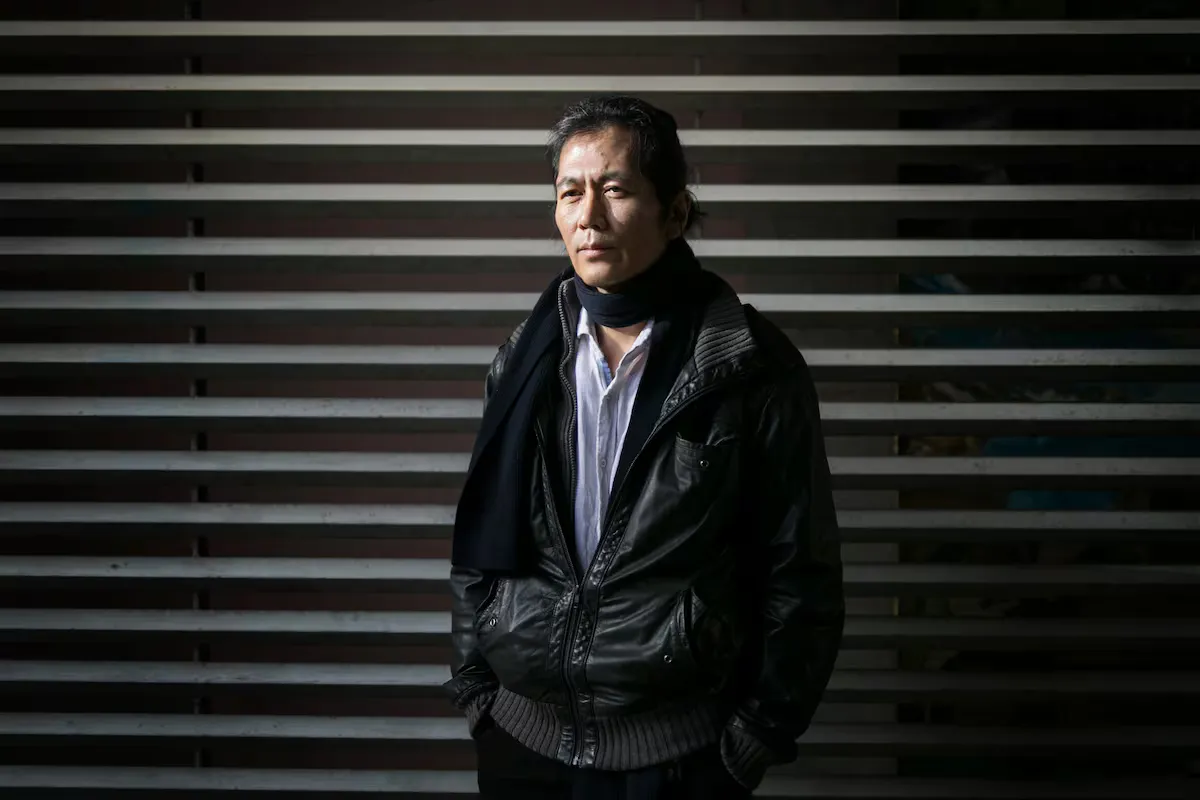
Two experiences dominated my past week. I finished reading Byung-Chul Han's "The Burnout Society," a book that examines how we live in an age of collective self-exploitation. Meanwhile, I wrapped up a bootcamp on product sense, where we analyzed real market cases to build better intuition about developing digital products.
While I was learning how to "sense" and intuit my way toward better products, my reading outside my own field (sadly, something increasingly rare) was showing me how our society has lost the ability to feel.
I started asking myself: are the products we create symptoms or causes of the collective exhaustion Han describes?
And more importantly: can product sense, as a competency, be part of the solution, or is it just a sophisticated version of the problem?
The paradox of the exhausted designer
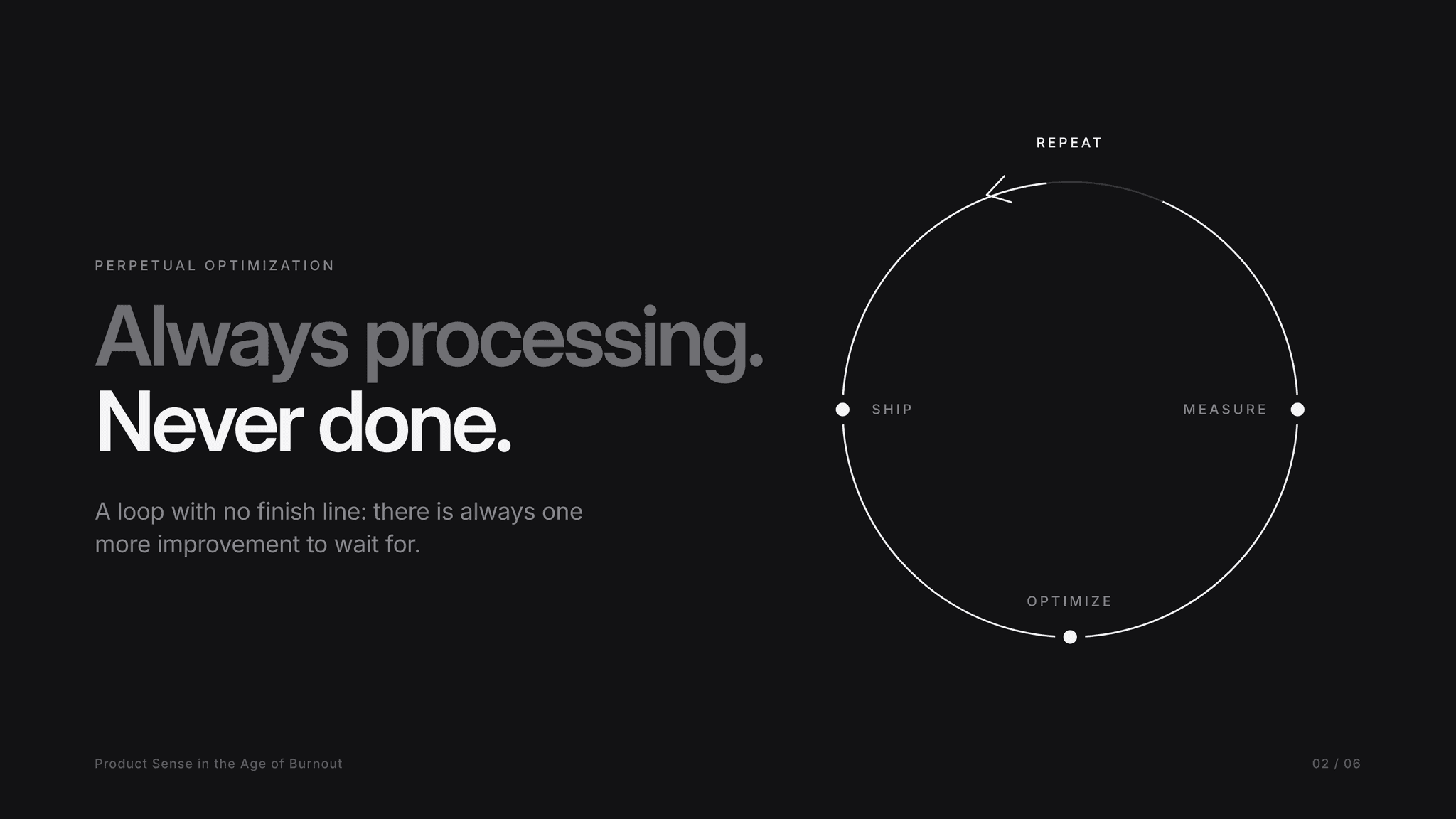
Han coined the term "burnout society" to describe our age of perpetual self-exploitation. It is no longer external forces that exploit us, but our own compulsion to constantly optimize, perform, and produce. We are the boss and the employee, the exploiter and the exploited.
This made me reflect on a paradox I live with every day:
How do we develop genuine product sense when we are operating in a state of chronic exhaustion?
And, more importantly, how do we create products that don't perpetuate this cycle of depletion for our users?
Product sense, that almost intuitive ability to "feel" what makes a product work, has become one of the most valued competencies in the digital world. But I noticed something curious: when we turn intuition into a competency to be optimized, something essential gets lost along the way.
Han argues that the burnout society replaced the disciplinary "you should" with a limitless "I can." No one is giving us orders anymore, so the unlimited "can" becomes a demand we place on ourselves. In the product context, that internalized pressure sounds like this:
"I must have unique insights into user behavior."
"I must spot opportunities no one else has seen."
"I must predict trends before the competition."
This constant pressure to perform in product creates a vicious cycle.
The harder we try to force insights, the less we are able to actually see our users. The more we chase the next revolutionary feature, the less attention we pay to the fundamental problems we already know exist.
But here the central paradox emerges: even recognizing the dangers of the burnout society, we can't simply abandon the pursuit of innovation. The world needs better products, solutions that genuinely improve people's lives.
The question is not whether to stop innovating, but how to learn to innovate sustainably.
Balanced innovation requires a fundamental shift in perspective: from innovation as performance to innovation as care.
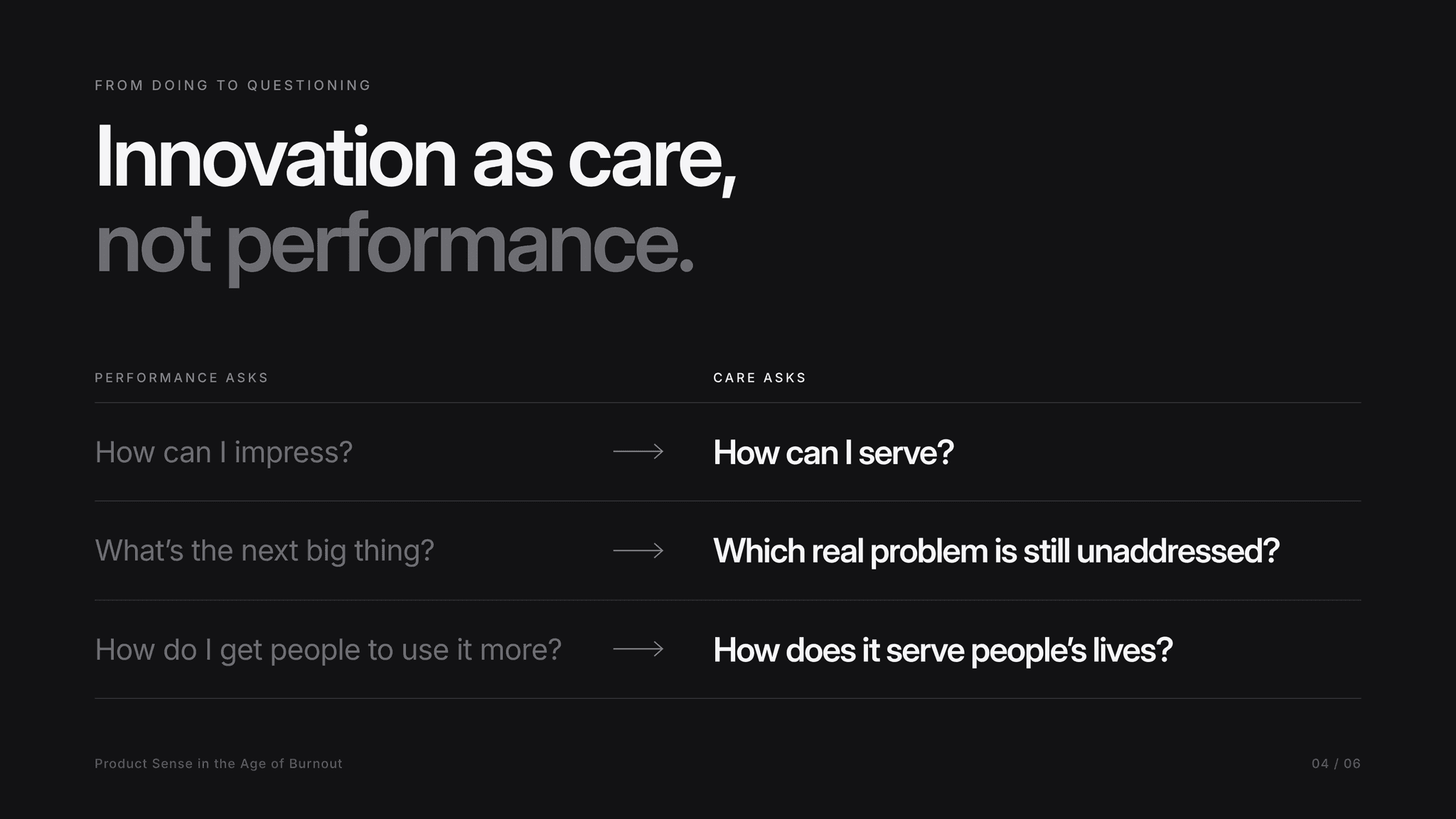
Instead of asking "how can I impress?" we ask "how can I serve?" Instead of "what's the next big thing?" we ask "which real problem has not yet been adequately addressed?"
This shift in focus from the extraordinary to the essential is liberating.
When we stop chasing innovation as an end in itself and start seeing it as a means to solve real problems, we naturally find the balance between urgency and contemplation, between action and reflection.
The trap of infinite optimization
The products we create often mirror our own state of mind. When we are stuck in the cycle of perpetual optimization Han describes, our products do the same to our users.
Think of productivity apps. They promise to free us from chaos, but end up creating new forms of anxiety:
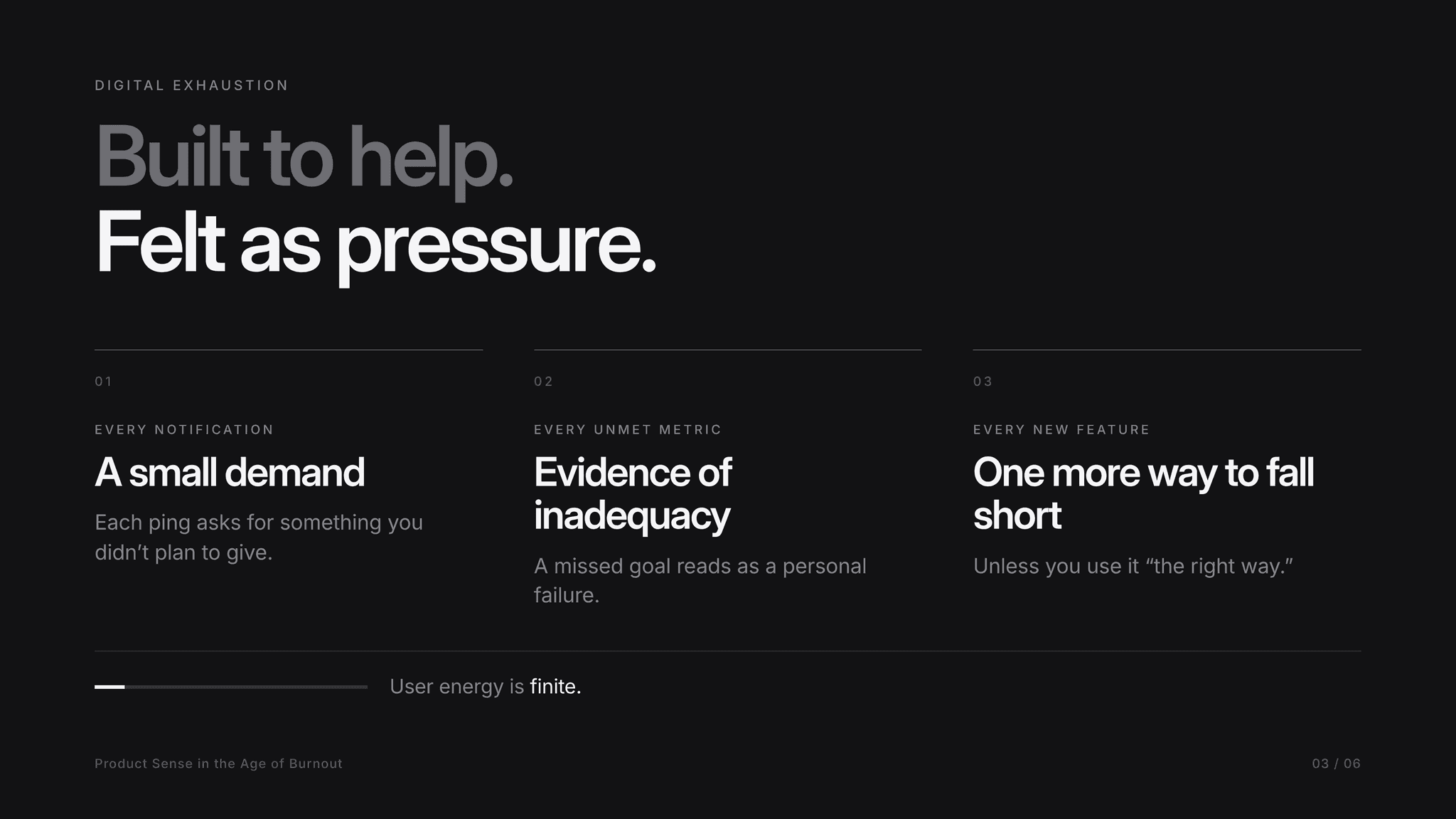
Every notification is a small demand.
Every unmet metric is evidence of our inadequacy.
Every new feature is a new way to feel insufficient if we don't use it "the right way."
In the bootcamp, we analyzed a practical problem: users buy something on Mercado Livre, aren't satisfied, but put off the return because it's inconvenient: printing a label, packing the item, going to a drop-off point.
It's a real UX problem that any e-commerce company should solve. But studying this specific case made me reflect on a broader question:
How do we distinguish between problems we should optimize and problems that may reveal something about how we are thinking about product?
Another look at product sense
But what if we saw product sense not as a skill to be performed, but as a capacity to be cultivated? What if, instead of optimizing a product for engagement and retention at any cost, we optimized for what Han calls the "contemplative life"?
The contemplative life, for Han, is about preserving spaces for pause and genuine presence, states our society considers "unproductive" but that are essential for real insight. In the product context, this means creating experiences that respect those moments, that don't compete desperately for attention, that know when to step back.
That's why I believe product sense could begin with a different question:
Instead of "how can I get people to use my product more?", we ask "how can I make my product genuinely serve people's lives?"
This shift in perspective has some practical implications:
Designing for sufficiency
Creating products that know when to stop. Interfaces that don't compete for attention, but that help and then step away. Features that solve specific problems without creating new ones.
Cultivating presence, not performance
Developing product sense through patient observation, not frantic brainstorming. Spending real time with real users doing real things, with no research agenda, no hypotheses to validate. Just curious presence.
Valuing the invisible
Recognizing that the best product sense often results in simpler products, not more complex ones. In features that don't need to exist. In problems we solve not by creating something new, but by removing something that already exists.
Rethinking the returns case
Back to the Mercado Livre problem, which is fundamentally about removing friction from a tedious but necessary process. The user wants a resolution that feels simple and natural.
The obvious solutions are real: home pickup of the item being returned, integration with delivery apps, simpler processes. These are legitimate UX improvements that any product should implement.
But Han's reflection made me think of a different question: when we optimize a process, are we always improving the user's life, or are we sometimes just making acceptable something that perhaps shouldn't exist in that form?
In the case of returns, the answer may be obvious: it's a real problem that needs to be solved better. But in other contexts, the question gets more interesting:
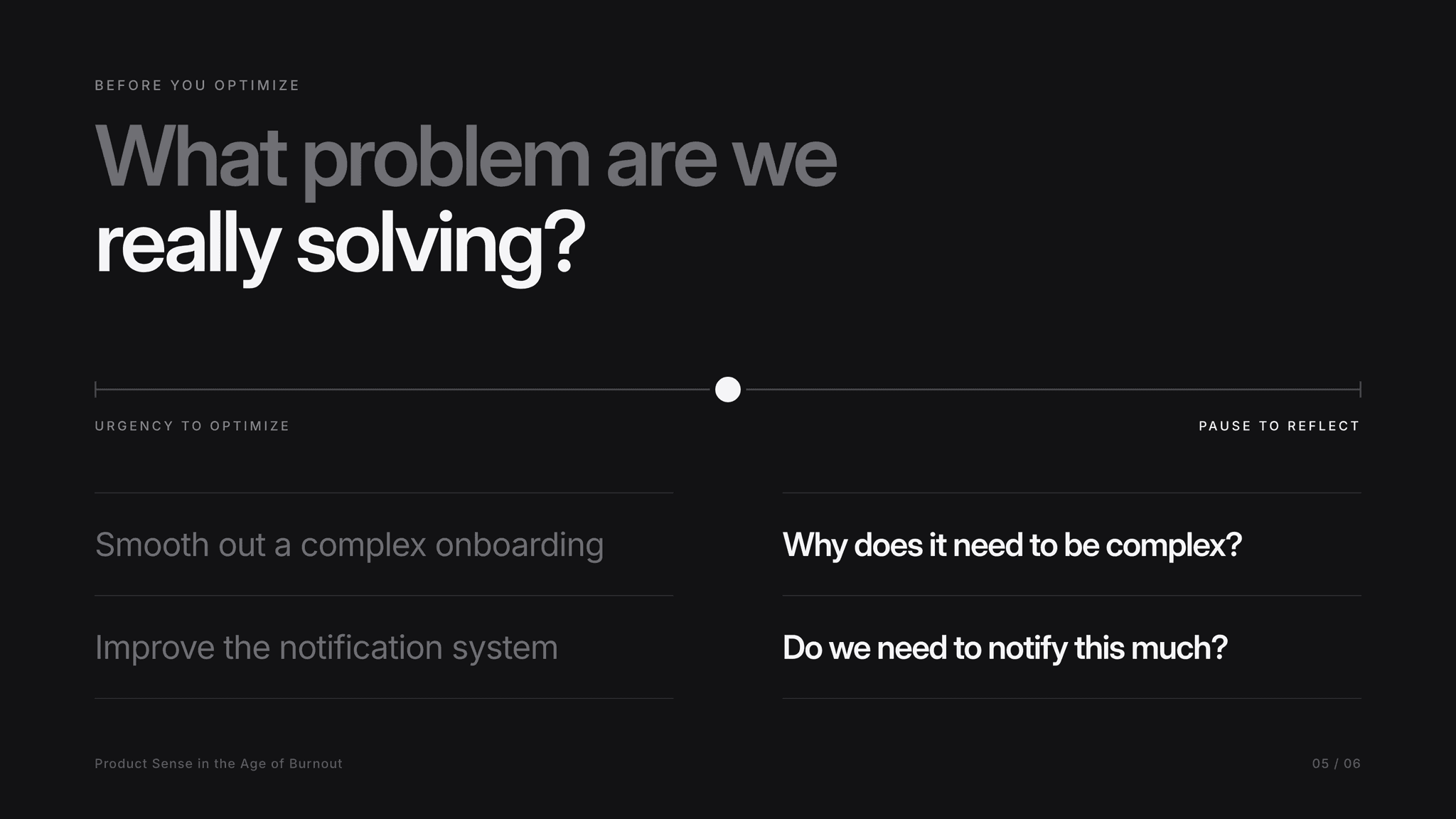
How often do we optimize complex onboarding flows instead of questioning why they need to be complex?
How often do we improve notification systems instead of asking whether we need to notify that much?
The user as a mirror
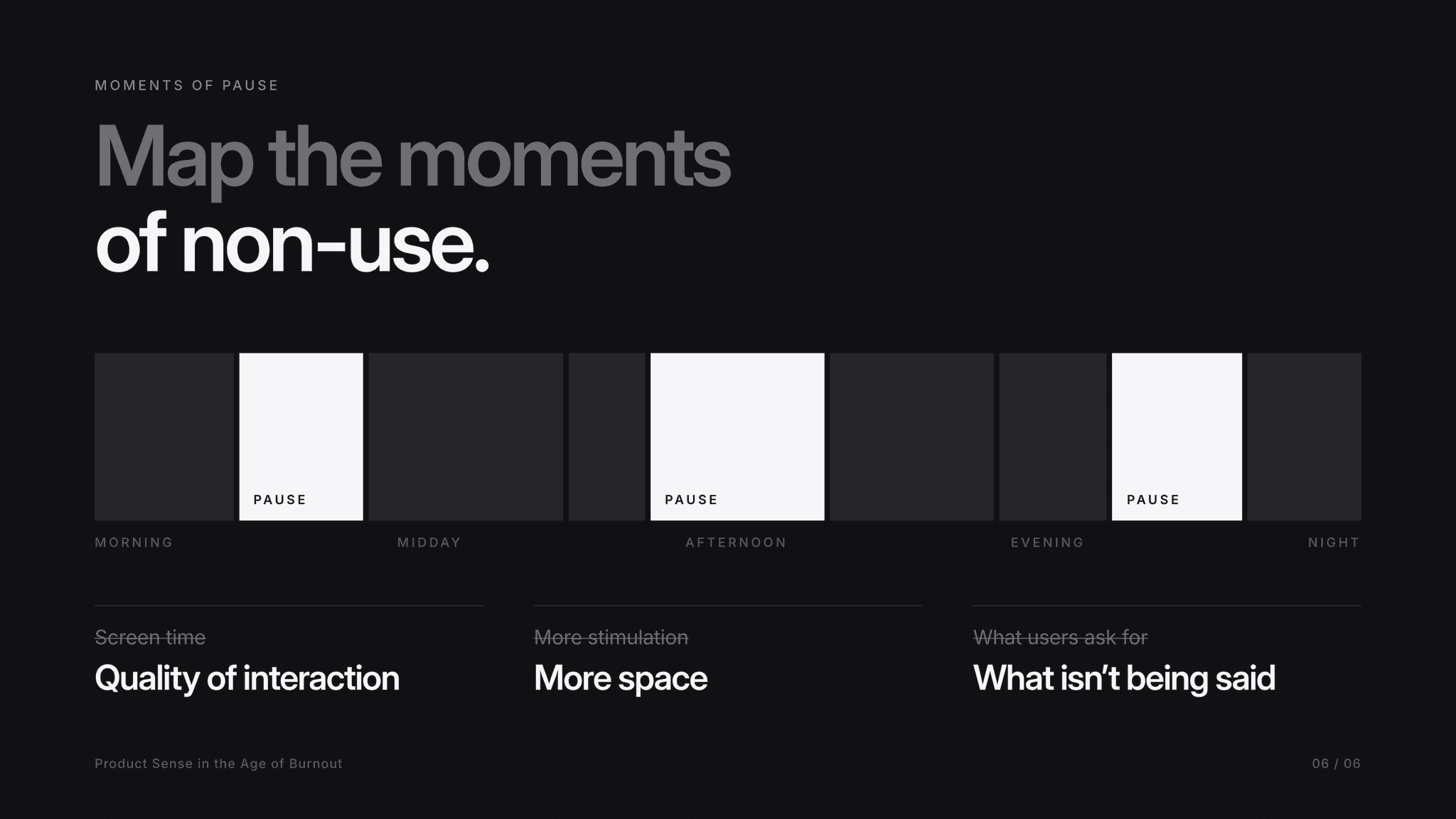
Han observes that in the burnout society we have lost the capacity for true idleness, those moments of pause that allow for insight and renewal. Our users are in the same state. They don't need more stimulation; they need more space.
This calls for a revolution in how we do user research.
Instead of mapping only journeys of intensive use, what about mapping moments of non-use? Instead of optimizing for screen time, what about optimizing for the quality of the interaction?
Tired users can't articulate their real needs. They will ask for features they think will solve their problems, but that actually just add more complexity.
Genuine product sense is the ability to hear what is not being said.
Resisting the burnout society through design
How do we develop product sense in a market that constantly pushes us toward performance and optimization?
Design for finite energy
Accepting that our users have limited energy to learn, adapt, and optimize. Every decision we force them to make is energy they won't have for other things.
Treating the user's attention as a non-renewable resource.
Metrics that matter to humans
Developing metrics that reflect real well-being, not just engagement. Quality over quantity. Satisfaction over addiction. Problem-solving over habit formation.
AI as a filter, not an oracle
Using artificial intelligence to process volume (analyzing thousands of reviews, transcribing hours of interviews, identifying patterns in behavioral data) while keeping interpretation and decision-making deeply human.
AI can free up our cognitive energy for what only we can do: understand context, pick up on emotional nuance, make unexpected connections. The danger is when we delegate the insight to the machine.
A final reflection
Han speaks of the need to recover our contemplative capacity.
In the product context, this translates into having the courage to create less. To say no to features that engage but don't serve. To solve real problems instead of inventing fictional ones to justify our solutions.
This is not anti-innovation. It is innovation directed at what really matters:
Creating products that honor human finitude instead of exploiting our compulsion for infinite productivity.
When we manage to move from performance mode into presence mode, we discover something surprising: product sense is not about having answers to everything, but about asking the right questions. And the most important question may be: how can I create something that makes people more human, not less?
And you? How do you see this tension between optimization and humanity in your product work?
If this reflection resonated, I'd love to hear about your experiences navigating these questions day to day.
References
The Burnout Society, Byung-Chul Han. The book that inspired this entire reflection.
Product Sense: Engineering Your Ideas into Reality, Dr. K R Suresh Nair. A very interesting read on this highly valued competency in the product world.
Product Sense Demystified, Marty Cagan. In this article, Marty Cagan demystifies the concept of product sense and explains how to develop this fundamental skill.
Translated from the original Portuguese: Product Sense na era do esgotamento, UX Collective Brasil.